skip to main |
skip to sidebar
There is always something new for us. The little restaurant has been running for about three years under our radar. Close by Chez Bob and Rouge, on Beatty Ave. it doesn't make it to the Age Good Food Guide but it should. It's a very pleasant place with white linen good cutlery and crockery and some sort of rustic, rudimentary farm instruments and a sled decorating one wall.
The Winter menu is about to change to the Spring menu, which we were told would be little different. The menu is on a single small sheet and, at present, is very hard to read in dim light. Prices are 'normal' for good suburban restaurant with mains around $36 and entree's about $17. They allow BYO wine on Tuesday and Wednesday with corkage of $5/person. There is a special lunch menu on a black board.
We had a very enthusiastic and patient waitress who brought thick slabs of house made bread with oil and salt, and butter on request.
We tried three entrees.Their tomato and caramelised onion tart with Woodside goats curd $17.50 looks nice but is very ordinary.
Pumpkin gnocchi, veloute were very soft and had fine flavour but at $3.20 each they are remarkably expensive.
Semolina dusted Port Phillip calamari, rocket, house made tartare were tender and had good texture. the tartare was excellent.
Wild caught barramundi with lemon risotto with a crab bisque was a a respectable but not very exciting dish.
What was fantastic, and worth a return trip, was a stuffed slow cooked lamb shoulder to share. This came with seriously over roasted vegetables, tomato, eggplant and zucchini
and crisp roast potato.
The lamb was absolutely superb. You could not ask for anything better. Nicely presented on a wooden board it was extremely tender with a delicate taste and not dominated by fat which is often a feature of lamb dishes.
They have a very limited dessert menu.
This is a very pleasant restaurant for a decent, reasonably quiet meal. They did have some background music for which they reduced the volume for us.
Score: 13.5/20
 I rarely look at them but letter box drops of pizza outlets, cafe's and restaurants must work or they would stop. Kabaul left one in our friends, Neil and Dorothy's letter box and they invited us to join them there. Little did we suspect that a couple of days later they would be offering a heavily discounted meal through OurDeal.
This is a fairly comfortable airy establishment, especially if you are near the door. Major decoration is alternating huge modern paintings interspersed with Afghani rugs hanging on the wall. There are also a few hookahs on the bar.
We got to trying a good range of their dishes staring with three dips. I found them disappointing on two counts, flavour, bland or too sharp and they were the same as the sauces provided with the main courses! Things improved rapidly from then on. Our waitress was very anxious to please and loved hearing us heap praise on the food. stay@lititzhouse.comService was good, without having to wait too long for dishes. Warm Turkish style bread seemed to be in endless supply and mains could be eaten with either bread or rice. We had three more entrees. Ashauk was chives wrapped in a soft pastry topped with lentils and yoghurt. I think we all enjoyed it. I certainly did.
 Another entree, bolani, which is excellent on a winters night was a grilled flat bread with a potato filling.
 Our last entree was bodinjan borani, eggplant with a tomato and herb dressing. the eggplant was excellent but the combination with tomato is not to every ones liking.
 The mains were particularly good. Lamb dopiaza, slow cooked shoulder was meltingly tender and came with a small salad.
 Mantoo, which is an entree, but could be a main, is another really friendly dish consisting of steamed dumplings filled with a lamb mince, onion, coriander, (not too much) and cumin. The dumplings are topped with lentils,tomato sauce and a drizzle of garlic flavoured yoghurt sauce. It's hard not to love this dish
.
 Kebabs, chicken
 or beef, are available every where. These were presented as large pieces of meat on flat skewers with rice and a small salad.
 They were lightly cooked, as we requested, and both tender and extremely tasty. We also had a couple of their classic desserts, a variation of a sticky date pudding which was more like a date cake,
 and a strange sweet flavoured with rose water and served up as a set of medallions. Not much to my taste.
 We ended up paying about $50/head for a very decent meal, fair value even without a discount voucher.
Score 13.75/20
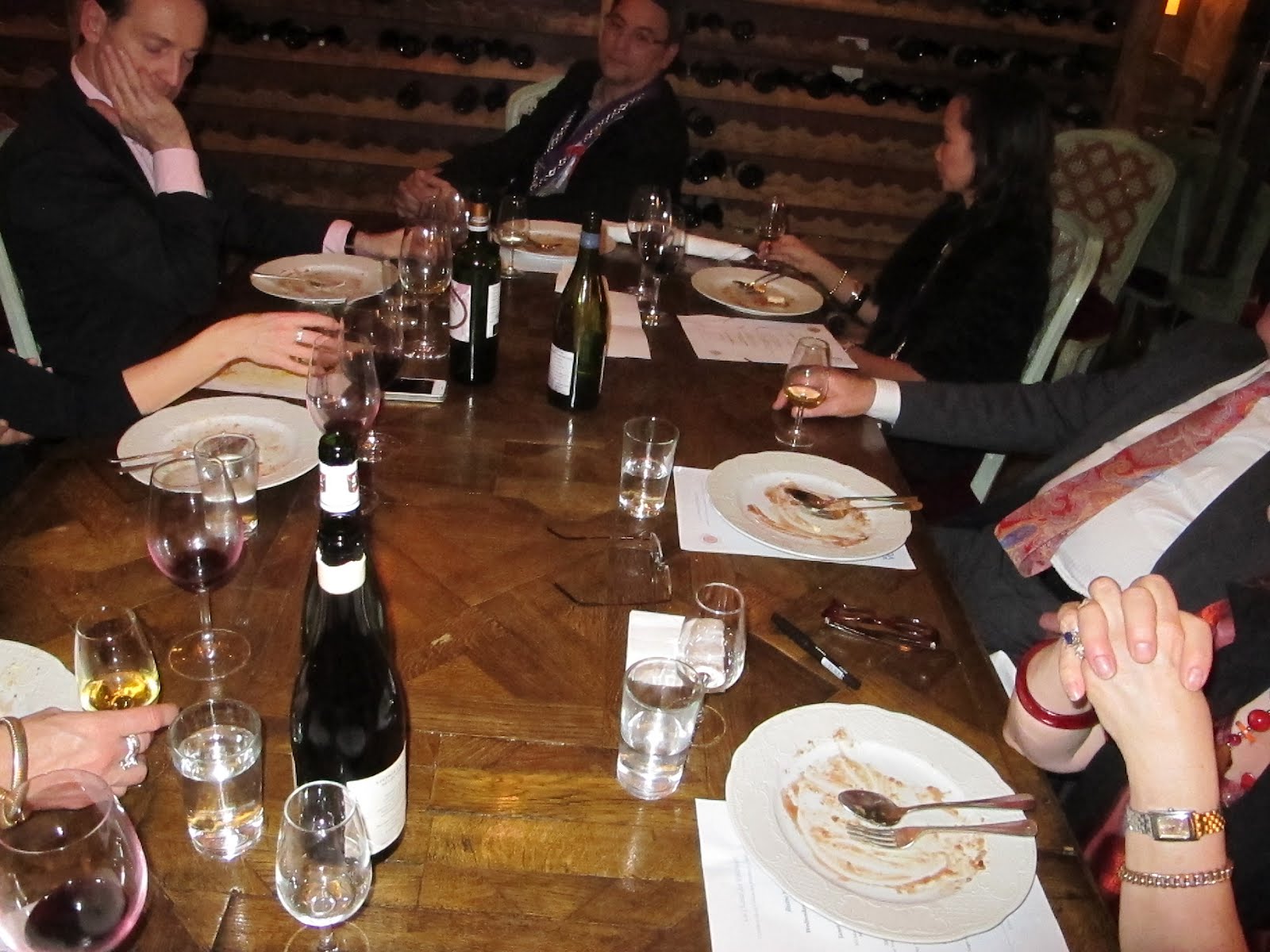
We enjoyed a very fine meal here, certainly above and beyond what onem ight ordinarily expect at a bistro. Of course this is not an ordinary bistro. Furnishings are plush, table tops are made from a parquetry floor bought on eBay and imported from Argentina
 and cooking is art rather than industry. After a couple of bite size amuse bouche, a snail, escargot on a little garlic butter with a crust of parsley and a steak tartar topped with a lightly fried quail egg which were both delicious, I could happily have had a lot more of both of them, served with a NV Moet et Chandon Imperial Brut Champagne.
 A lovely entree came next, Tasmanian trout, with toasted brioche which was first cured with sugar and salt for a couple of days before being smoked for seven minutes over hickory. It would have been excellent even by itself but was even better with a few added extras such as a light salmon mousse, thin sliced pickled onion and some greens and lemon. All the wines were presented masked. We had this with a 2008 Andre Kientzler Reisling Giesberg from Alsace and a contrasting 2010 Pierre Yves Colin Morcy St.Aubin "Les Champlots" Premier Burgundy. Both wonderful and complex wines, I preferred the Burgundy.
 This was followed by an 'Assiettte de porc' with a calvados sauce and which had pork belly, tenderloin, a little poached apple and black pudding on a bed of Puy lentils and came with a green salad. If you have no objection to pork this is a fantastic dish. We were served two reds with this, a 2009 Caronne St.Gemme Haute Medoc - Bordeaux and a 2010 Yanne Chave Crozes "Le Rouvre" from the Northern Rhone. South of Burgundy this is just across the river from France but you can purchase all these wines, without an I from Prince Wine store if you are lucky enough to live in Melbourne. We could not favour one above the other of these two wines.

 The meal was completed with a Gateau Basque an absolutely superb frangipany tart topped with a poached pear.
 This was accompanied by a 2007 Chateau Coutet Sauterne from Bordeaux which was rich and sweet with very little of the bitterness associated with botrytis. Coffee and perfect Canales was served with Logis de la Mothe Cognac Vielle Reserve. A Cognac that could convert anyone to spirits.
 Chef answered a some queries about the meal.
 On the way home a breathalyzer test was, apparently, very close to the .05 mark and I was advised that it might still be rising!
An exceptionally fine meal.
Score 17/20.
We live in a remarkable age which is so different from the time when I grew up as to be almost unrecognizable. It shows in every aspect of our lives and cuts across all social classes. It is seen in the cloths we wear, the things we do in our leisure, the sort of work we do, the food we eat and especially in such simple customs as the beverages we consume and how we prepare them. We have written previously about tea, it's history and something of its varieties.
Tea and coffee are the most common beverages consumed world wide. Tea has a much longer history than coffee which has gradually become more prominent. for reasons that are difficult to discern. Coffee has come to replace tea in many social situations and has spawned a plethora of devices for its service and preparation. This photo shows a few of the commonly available apparatuses, from the left a percolator, an individual plunger pot, a larger plunger pot with two filters, an espresso device and a cappuccino maker. In the background is a coffee grinder purchased in Turkey. It is made from a WW2 shell case! This percolator can be set to make coffee at a convenient time up to 24 hours ahead.
 The coffee tree is native to East Africa from here traders took it to India and, about 1700, Java and subsequently to the Caribbean and to South America. Brazil, Vietnam and Columbia are the largest exporters of coffee today according to McGee.
Initially used to make a tea like concoction using the raw beans and leaves there have been several major developments in coffee making. First roasting and grinding the beans, this is still represented in the middle eastern version often called Turkish coffee. A fine grind of the beans is mixed with water and sugar and brought to the boil several times before being served. Cardamom seeds are often added for flavour Ethiopian women have a 'coffee ceremony' at which they husk coffee beans, roast them over an open flame in a pan, grind the beans and pour boiling water over them. This ritual is part of a the social fabric of village communities.
In the next development the coffee grounds were separated from the liquid. This was introduced by the French in about 1700 by enclosing the coffee in a bag resulting in a less gritty brew. The next major development came about 1750, also from the French. The drip pot allowed hot water to pass into a separate chamber. This produced a sediment free coffee which had been produced with water below boiling point and only in contact with the ground beans for a few minutes. This reduced bitterness and astringency and allowed more prominence to the aromas that appealed to European tastes. Incidentally there is also a cold drip method which takes hours to produce a cup of coffee. This method fails to extract many of the beans aromatic compounds.
The next major developments were expressions of the machine age. Percolation and plunger pots preceded the introduction of Espresso at the Paris Exhibition in 1855. This process of forcing hot water through the grounds under pressure "extracts a substantial amount of the coffee beans oil and emulsifies it into tiny droplets that create a velvety texture and lingering flavor..." (McGee) Ingenious methods have been found to reproduce this process for domestic use from machines which grind the beans , pack them and force water through them with the ability to alter the grind, the rate of flow through it and the volume of liquid. This De Longhi machine has great flexibility. The ultimate in efficiency and mess free convenience is approached with the development of coffee pods. Apparatuses using these sealed capsules of ground coffee sell for anything upwards of $80 to $1000's may also come with attachments that heat or froth milk or provide hot water. The Blue Pod Coffee Co. will provide a Lavazza Maxi Espresso machine, as pictured, which costs about $500 upwards, for free to offices which use their pods for at least two cups of coffee daily. They have loaned me one of these machines with pods for Espresso, single and double strength and decaffeinated brews which make very good coffee. They can be contacted at www.bluepod.com.au
 There are many factors, apart from the more than 800 aromatic compounds that can be extracted from coffee beans, that contribute to the taste of a cup of coffee. Most important among these is the water used for the brew. If it insufficiently acidic or hard this will have a big influence on the taste. Distilled water and chlorinated water should be avoided.
This is just a smattering of the plethora of information available about coffee. Most of it has been taken from "On Food and Cooking The Science and Lore of the Kitchen" Completely revised and updated 2004 by Harold McGee.

 Cut and still drying,
 Floured.
 Preparing a sauce.
 Ready for completion.
 The dish.
 Something to drink,
 and to finish the meal cheeses including this outstanding triple cream brie